
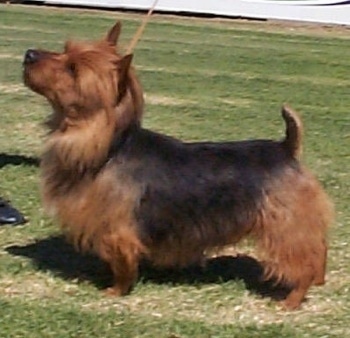
A.Ch. Teraustralis Bradman
aw-STREYL-yuhn TAIR-ee-uhr
The "Aussie," as it is affectionately known, is one of the smallest in the Terrier Group. The Australian Terrier is a sturdy, short-legged, little dog. It has a long head, with erect, V-shaped ears and dark brown eyes with a keen expression. The nose is black with an inverted V-shaped area above it. The teeth are good sized and should meet in a scissors bite. The body is a little longer than it is tall with a level topline. The chest is deep, set well under the body. The feet are small and catlike. Toes are arched and compact, nicely padded turning neither inward nor outward. The nails are black. When an Aussie puppy is a few days old the dewclaws are usually removed. The Australian Terrier has a weatherproof double coat that is about 2-3 inches (5-6.5 cm) long. Coat colors include blue and tan, solid sandy and solid red. Shades of blue include dark blue, steel-blue, dark gray-blue or silver-blue. In the silver-blues, each hair carries blue and silver alternating with the darker color at the tips. There is a topknot covering only the top of the skull, with a finer and softer texture than the rest of the coat.
The Australian Terrier is a tough, cheeky little fellow with courage that reminds people of a much larger dog. It has boundless energy and is very loyal, showing great affection for its immediate family. Its extraordinary intelligence makes it a responsive and very protective companion. It is an alert, amusing and loveable little dog. Spirited, curious, and self-assured, it has very keen hearing and eyesight, making an excellent watchdog. It wants to please its master and is more easily obedience trained than most other terriers. This breed is not snappish. It likes to bark, and must be told after it first alerts you of something, enough is enough, no more barking. An Australian Terrier that is pack leader of its humans may snap at children. Children need to be taught how to be kind to the dog, but also how to be the dog’s leader. They are friendly with other dogs as well as other pets. However they may chase small animals outside the house and should be in a safe area at all times. Socialize this breed well. This is a good dog to travel with. The training of the Australian Terrier needs to be strict because this self-confident dog prefers to follow its own ideas, although it learns very quickly. The Australian Terrier is a very economical breed to feed. Make sure you are this dog's firm, confident, consistent pack leader to avoid Small Dog Syndrome, human induced behavior problems, along with territorial issues. Always remember, dogs are canines, not humans. Be sure to meet their natural instincts as animals.
Height: 9 - 11 inches (23 - 28 cm)
Weight: 9 - 14 pounds (4 - 6 kg)
Generally healthy.
The Australian Terrier is good for apartment living. It is fairly active indoors and will do okay without a yard provided it is taken for walks on a lead. They should not be allowed to roam free because they have a tendency to chase.
The Australian Terrier is an adaptable little dog that needs to be taken on a daily walk. They enjoy the chance to romp and play in a safe area.
About 15 or more years
Average of 4 puppies
The stiff, long, shaggy coat is easy to care for and does not need clipping. Simply brush several times a week, being gentle with the soft undercoat. Brushing stimulates natural oils and will soon bring the coat to a high gloss. Because the breed standard is for a hard coat, don't wash this terrier too often; any more than about once a month will make the coat lank. The coat should be brushed while it dries. Be sure to trim around the eyes and ears, if necessary, with blunt-nosed scissors. It also requires plucking about every three months. The nails should be clipped regularly. The Australian Terrier sheds little to no hair.
Developed in Australia and one of the smallest working terriers, the Australian Terrier was first shown as the Australian Rough-Coated Terrier in 1868 in Melbourne, Australia. Officially recognized in 1933, the breed was probably created by crossing many terrier breeds including the Irish, Cairn Terrier, Norwich Terrier, Dandie Dinmont Terrier, Yorkshire Terrier, and the Skye Terriers. He was used for rodent and snake control, as a watchdog, and even as a shepherd and as a companion. The Australian Terrier was the first breed to be recognized as native to Australia in 1868. It was first recognized by the AKC in 1960. Some of the Australian Terrier's talents are watchdog, tracking, agility and performing tricks.
Terrier, AKC Terrier
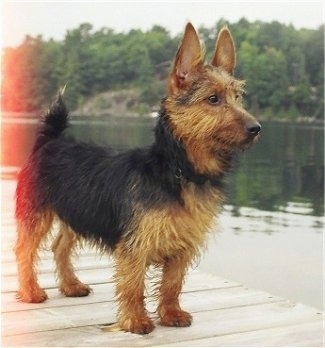
Jonty the Australian Terrier at 7 months
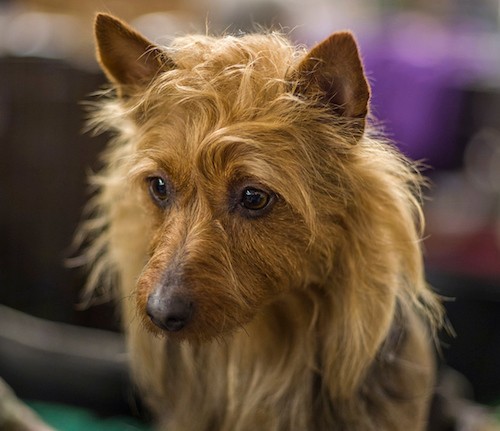
Photo courtesy of David Hancock
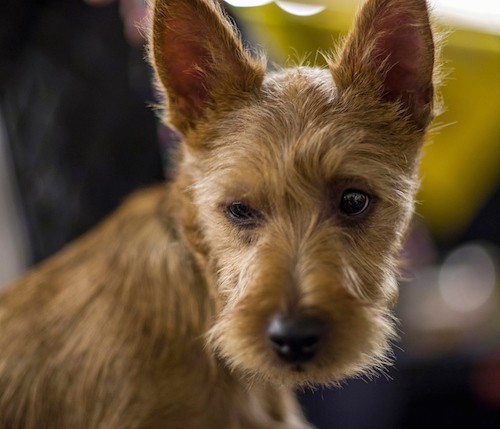
Photo courtesy of David Hancock
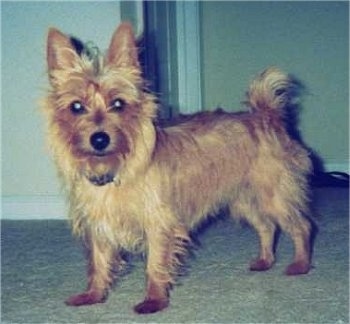
Scarlett the Australian Terrier as an adult dog.
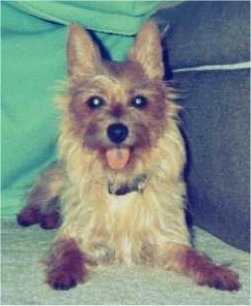
Scarlett the Australian Terrier as an adult dog.
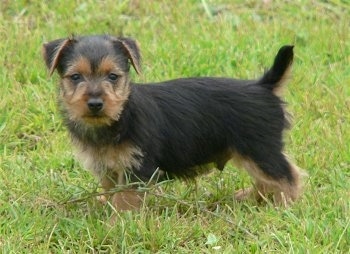
Winston’s “Roux” of Glen Eyre the Australian Terrier puppy