
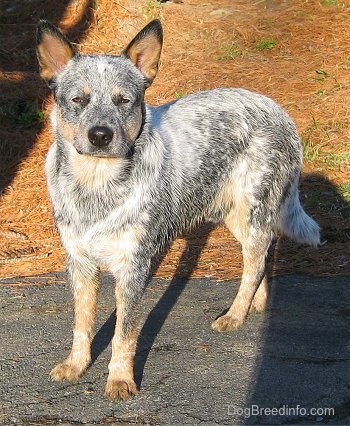
Max the Blue Heeler loves to herd the goats. There will be no goat stragglers with Max around; they must all be together in one large group. If not, Max fixes the 'problem' in a matter of minutes!
aw-STREYL-yuhn KAT-l dawg
The Australian Cattle Dog, also known as the Australian Heeler, Hall's Heeler, Queensland Heeler and Blue Heeler, is a courageous, tireless, robust, compact working dog. The dog is agile, well-muscled, powerful and determined while working. The length of the body is a little longer than it is tall. The tail is held moderately low, hanging at a slight curve. The front legs are straight, strong, round bone, extending to the feet. The feet are round and the toes are short. The skull is broad and slightly curved between the ears, flattening to a slight but definite stop. The ears are wide-set, moderate in size and pricked when alert. The nose is black. The dark brown, medium-sized eyes are oval in shape. The teeth should meet in a scissor-bite, with the lower incisors closing behind and just touching the upper. The ACD has a smooth double coat with a short dense undercoat. Coat colors include red speckled, blue, blue-mottled or blue speckled with or without other markings. The dogs with the red speckled coloring are called Red Heelers and the dogs with the blue coloring are called Blue Heelers. Black markings are not desired in the show ring. Puppies are born white because of a gene they inherited from the early Dalmatian crosses. You can sometimes tell the adult color by looking at the paw pads.
The Australian Cattle Dog is a loyal, brave, hardworking, herding breed. One of the most intelligent breeds, it is not the kind of dog to lie around the living room all day or live happily in the backyard with only a 15-minute walk. It needs much more exercise than that and something to occupy its mind daily or it will become bored, leading to serious behavior problems. It needs action in its life and will do best with a job. This alert dog is excellent in the obedience ring and will excel in agility and herding trials. Can be obedience trained to a very high level. Firm training starting when the dog is a puppy and a lot of daily leadership, along with daily mental and physical exercise will produce a wonderful and happy pet. Protective, it makes an excellent guard dog. It is absolutely loyal and obedient to its master. It is sometimes suspicious of people and dogs it doesn’t know. It can be very dog aggressive if allowed to be pack leader, for its dominance level is high. Teach your Australian Cattle Dog that you are alpha and you will not tolerate him fighting with other dogs. Well balanced Cattle dogs are good and trustworthy with children. Some will nip at people's heels in an attempt to herd them; an owner needs to tell the dog this is not acceptable behavior. If you are adopting a pet, avoid working lines, as these dogs may be too energetic and intense for home life. Australian Cattle Dogs are very easy to train. Problems can and WILL arise with meek owners and/or owners who do not provide the proper amount and type of exercise. This breed does best with a job to do. If you do not have time to extensively work with and exercise your dog, or do not fully understand canine instincts and their need to have leadership, this is not the breed for you.
Height: Males 17 - 20 inches (43 – 51 cm) Females 17 - 19 inches (43 – 48 cm)
Weight: 30 - 62 pounds (13 – 28 kg)
Prone to hip dysplasia and PRA. The merle-colored dogs are prone to deafness.
Not recommended for apartment life and does best with at least a large yard. Does best with a job to do.
These animals have incredible stamina and will enjoy all the activity you can give them. Exercise is of paramount importance—without enough they can become bored and destructive. Exercise cannot simply be tossing a ball. While they will enjoy this ball play, their brains need to be stimulated daily. Does best with a job. They need to be taken on long daily walks. Makes an excellent jogging companion. Do not allow this dog to walk ahead of you on the walks. He needs to be beside or behind you to re-enforce the human is alpha.
About 12-15 years.
1 to 7, average of 5 puppies
The shorthaired, weather-resistant coat needs little care and is very easy to groom. Just comb and brush with a firm bristle brush, and bathe only when necessary. This breed tends to shed its coat once or twice per year (depending on sex status and region).
Dogs the settlers brought with them from Europe, called Smithfield and the Old Smooth Collie (not the Smooth Collie known today), were not able to handle the long distances and inhospitable climate of the new continent. The Australian Cattle Dog was developed by pioneer settlers in the 1800s by crossing Dingo-blue merle Collies to Dalmatians and black and tan Kelpies. Some sources say the Bull Terrier breed may have been added as well. The result was dogs that were excellent workers, herding cattle on large ranches. The dogs worked the stock quietly yet forcefully, willing and able to drive cattle across vast distances under harsh, hot dusty conditions. With superior stamina, it was well suited to Queensland. Both its guarding and herding instincts are very strong. In 1893 a man named Robert Kaleski wrote a standard for the breed. In 1903 the standard was approved in Australia. In 1980 the breed was fully recognized by the AKC. The Australian Cattle Dog has also been known as the Australian Heeler, Hall's Heeler, Queensland Heeler and Blue Heeler. "Heeler" refers to its herding skill of snapping and biting cattle's heels. Its talents are retrieving, herding, guarding, agility, competitive obedience and performing tricks.
Herding, AKC Herding
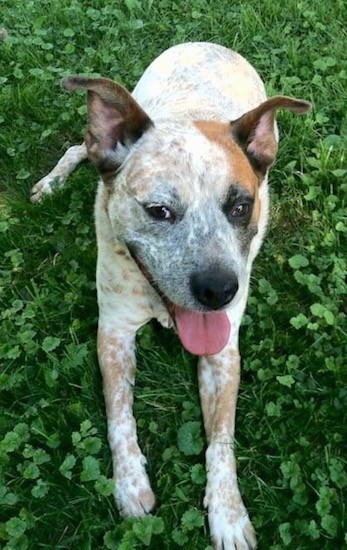
Layla the Red Heeler at 13 years old
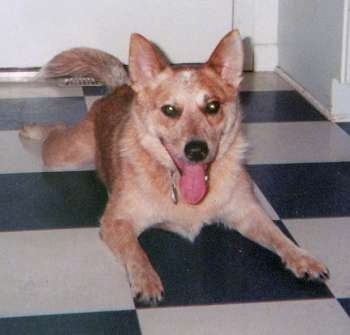
This is Griffin the Red Heeler in his breed-typical frog pose.
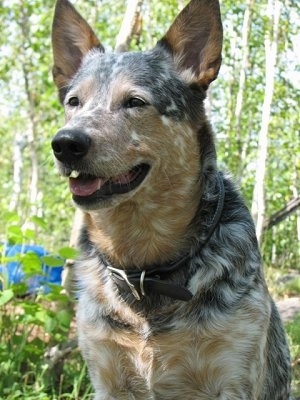
Ozzie the Australian Cattle Dog
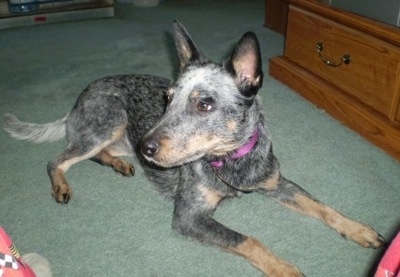
"This is Dekota, an Australian Cattle Dog at 3 years old. She is deaf and cannot hear, but she is very happy and easy going. She does not let her deafness stop her. Dekota and I are part of a K9 Search and Rescue team. She loves kids, giving them kisses and playing with them."
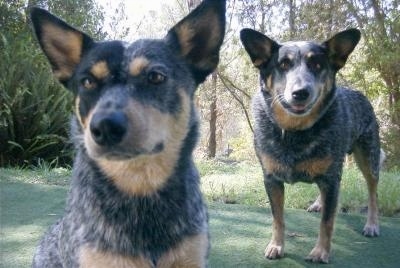
These two Aussies are from Australia. Australian Cattle Dogs in Australia look a little different than the American version of the breed.
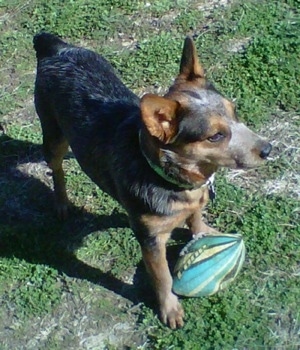
"This is Fancy. She loves to be busy working the horses. One of the things Blue Heelers are known for is their love of having a job to do. They have great stamina which makes them great for ranch dogs. She never gives up on me, that's for sure. I would not pick any other breed over her. She helps me on the ranch and is great with the grandkids. She may have been born just a Blue Heeler but Fancy is her name."
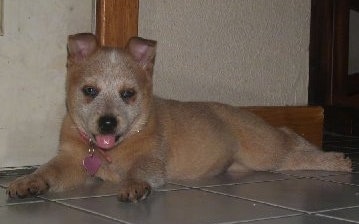
Cloey the red Australian Cattle Dog (Red Heeler) as a puppy at 8 weeks old—"This is Cloey. She is an eight-week-old Red Heeler puppy. She is very active and hyper and loves to play. She thinks she is a lot bigger than she is and will bark and stand up to any dog no matter what the size. Cloey is my brother's dog that we babysit while he is at work. She goes on a walk everyday, and while on the walk she tries to run ahead and lay down on shady spots, or tries to walk herself and the other dogs we walk.
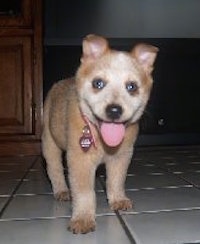
Cloey the red Australian Cattle Dog (Red Heeler) as a puppy at 8 weeks old
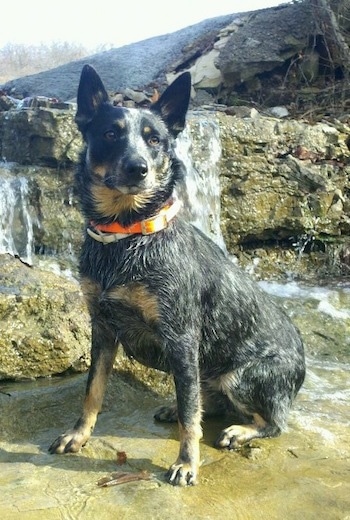
"Dually has exceeded my expectations that I had for the ACD. He holds true to the breed standard when it comes to stamina. This dog never gives up! He was attacked by what we believe was coyotes in the summer of 2011. He was missing for 3 days and showed back up all on his own. He had massive wounds, large bite wounds that were down to the muscles on his back right leg and his neck. He underwent 4 surgeries over the course of 2 months and full recovery took about 3 months. To this day you still can't slow him down. He has a very natural ability to work cattle and has done very well with it. I will never have another breed of dog. He sticks beside me at all times and has gotten protective over me but only when necessary. If mom lets someone in the house he knows that they are a friend. We get compliments on Dually everywhere that we go!"
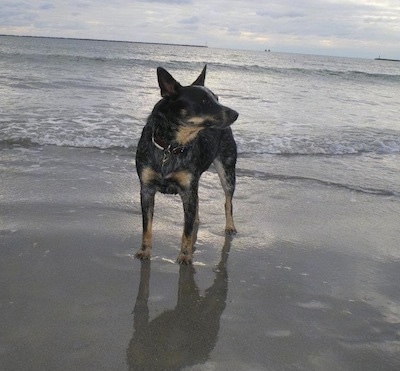
Dually the Australian Cattle Dog at 1 year old
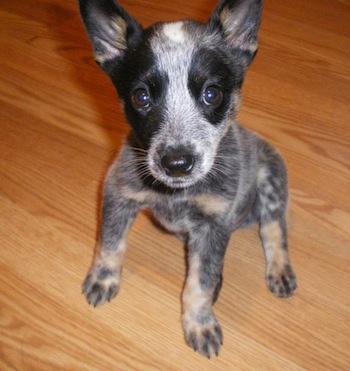
Dually the Australian Cattle Dog as a puppy
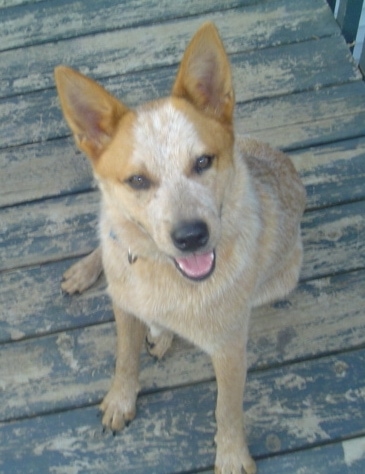
Ladue the Red Heeler at 6 months old—"Ladue is the same as a Blue Heeler except that she is red. Ladue loves to play with other dogs. She also loves to swim in my creek. She and my Boxador love to go to my neighbors and play/herd my neighbors Border Collie. Ladue's favorite toy is a ball, she and I always are playing soccer. She is a quick learner and really smart. She was given to me from the owner of the place where I go horseback riding. They had bought her with the intention of her being a herder, but she is to timid and nice. If I go a day without playing with Ladue she will go crazy!"