
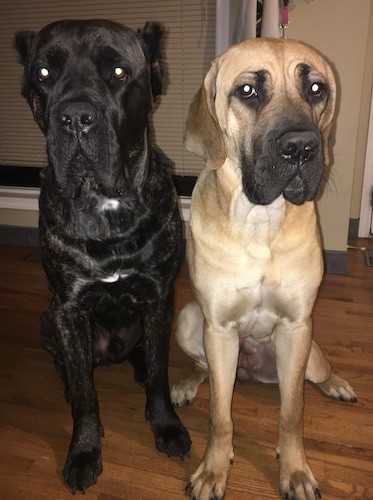
Hank (left) the Cane Corso at 4 years old with his best friend Rosie the Cane Corso at 10 months old. See more of Hank and Rosie.
KAH-neh COR-soh
The Cane Corso Italiano is a medium-big size dog, strongly built but elegant, with powerful and long muscles. Very distinguished, he expresses strength, agility and endurance. The general conformation is that of a mesomorphic animal whose body is longer than the height at the withers, harmonious as regards the form and disharmonious as regards the profile. The muzzle is very broad and deep. The width of the muzzle must be almost equal to its length which reaches 3.4/10 of the total length of the head. Its depth is more than 50% the length of the muzzle. Due to the parallels of the muzzle sides and to the fullness and the width of the whole jaw, the anterior face of the muzzle is flat and square. The nasal bridge has a rectilinear profile and it is rather flat. The lower side profile of the muzzle is determined by the upper lips; the suborbital region shows a very slight chisel. The stop is very marked because of the very developed and bulging frontal sinuses and because of the prominent superciliary arches. The neck is slightly arched. The neck shape is of oval section, strong, very muscular. The body is compact, strong and very muscular. The skin is rather thick. The neck is practically without dewlap. The head mustn't have wrinkles. The pigment of the mucous membranes is black. The pigment of the soles and the nails must be dark. The coat is short hair but not smooth, with vitreous texture, shiny, adherent, stiff, very dense, with a light layer that becomes thicker in winter (but never crops up on the covering hair). Its average length is approx. 2/2.5 cm. On the withers, the rump, the back margin of the thighs and on the tail it reaches approx. 3 cm without creating fringes. On the muzzle the hair is very short, smooth, adherent and is not more than 1/1.5 cm. Color: black, plum-gray, slate, light gray, blue/gray, light fawn, deer fawn, dark fawn and tubby (very well marked stripes on different shades of fawn and gray). In the fawn and tubby subjects there is a black or gray mask only on the muzzle and shouldn't go beyond the eye line. A small white patch on the chest, on the feet tips and on the nose bridge is accepted.
Very loyal, willing to please and quiet around the house, the Cane Corso is highly intelligent and very trainable. Active and even-minded, he is an unequalled watch and protection dog. The Cane Corso Italiano is great with children in the family. Docile and affectionate with the owner, they are protective yet gentle. The Cane Corso has a very stable temperament. It makes an excellent guard dog and watchdog. It will not wander from the home. They stick close to their masters. If necessary he becomes a terribly brave protector of people, house and property. The Cane Corso is not a fighting dog. They were bred as powerful working dogs for hundreds of years. Therefore they will not go out "looking" for a fight, but on the other hand they will not back down from other dogs who try to dominate them. The Cane Corso requires an experienced owner who knows how to display a natural authority over the dog. It can be aggressive with strangers and other dogs if not socialized or if it sees itself above humans in the pecking order. It should be carefully socialized when it is a pup. It is highly recommended that these dogs become fully obedience trained. If a Cane Corso is fully trained with an owner who is firm, confident and consistent, setting rules the dog must follow and placing clear limits to what he can and cannot do, along with providing the proper daily mental and physical exercise, the Cane Corso will be an amenable companion. Learn what makes the canine animal tick and treat his breed accordingly. Suspicious of strangers, but wonderful with the family, a well-balanced Corso will put up with strangers if the owners are present. When raised correctly, the dog should be submissive to all members of the family. Corso ears were originally cropped to help them ward off wolves while protecting livestock. Their ears are much more sensitive than the rest of their bodies. Generally, they're practically impervious to pain otherwise, so many Corso owners are often disappointed to find that electric "invisible fence" containment systems don't deter their dogs.
Height: Males 24 - 27 inches (64 - 68 cm) Females 23 - 25 inches (60 - 64 cm)
Weight: Males 99 - 110 pounds (45 - 50 kg) Females 88 - 99 pounds (40 - 45 kg)
This is a robust dog with typical bone and joint problems of the giant breeds.
The Cane Corso will do okay in an apartment if it gets enough exercise. They will be content to live outdoors provided they have adequate shelter.
This very athletic breed needs a lot of regular exercise. They make excellent jogging companions, and if not jogged daily, should be taken on at least one long, brisk daily walk.
About 10-11 years.
About 4 to 6 puppies
The Cane Corso does not require much grooming. Occasionally comb and brush to remove dead hair. This breed is a light shedder. Some Cane Corso may drool or slobber, especially in hot weather or after getting a drink.
The Cane Corso Italiano is the original Cane Corso breed. It originated in Italy. It is closely related to the Neapolitan Mastiff. For years he has been a precious companion of the Italic populations. Employed as property, cattle and personal guard dog and used for hunting purposes too. In the recent past he has found an excellent preservation area in southern Italy, especially in Puglia, Lucania and Sannio. The name Cane Corso means "running dog" in Italian. Cane means "dog" and Corso means "course". Coursing is the sport of pursuing game with dogs that follow by sight rather than by scent. The Cane Corso was accepted into the AKC's miscellaneous class in 2008.
Mastiff
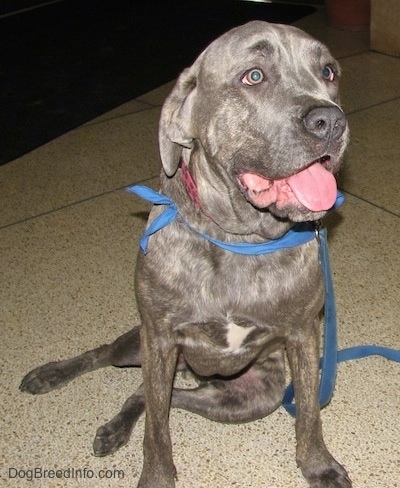
Zeus the Italian Mastiff at 1 year old
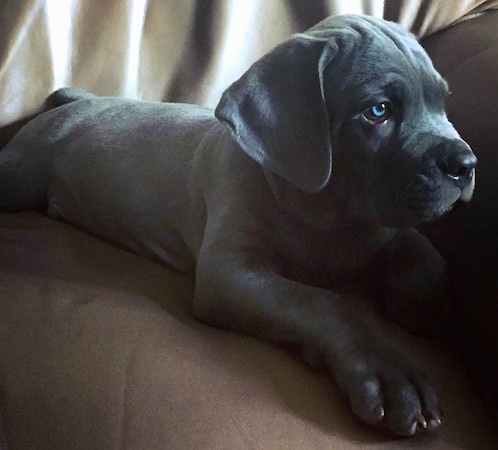
Khan the blue-eyed Cane Corso Italiano puppy at 9 weeks old—"Khan is 9 weeks old and weighs 20 pounds. He's a smart little guy who has already shown signs of guarding the house. He is learning all the time from his 4-year-old Great Dane sister, Zendri. He has also brought out her inner puppy and she is loving her little brother."
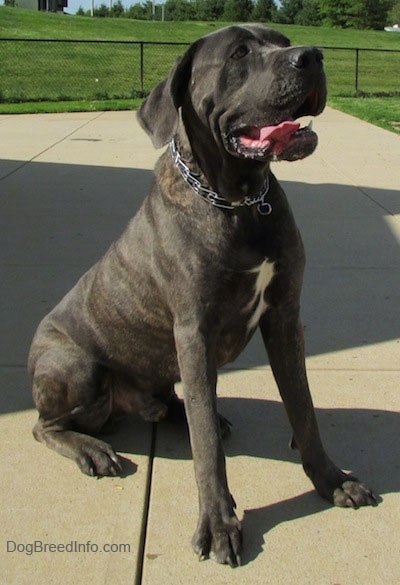
Shady the Cane Corso Italiano at 2 1/2 years old
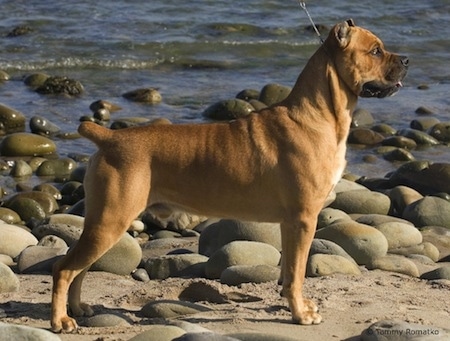
GCH Campo's Solomon di RockHaven the Cane Corso Italiano at 5 years old—"Solomon is the very first AKC Champion of the cane corso breed. He has multiple working titles as well."
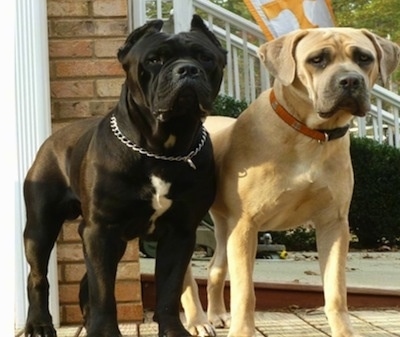
"Nero and Cassie are a result of superior breeding from the finest imported and domestic bloodlines. They are AKC and ICCF-registered." Photo courtesy of Brusco's Cane Corso
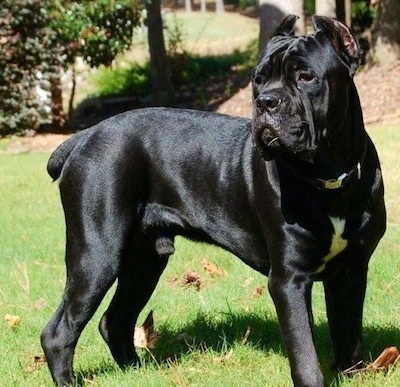
"This is Nero at 1 1/2 years old, weighing 125 pounds. Nero is a result of superior breeding of the finest imported and domestic bloodlines. His temperament is absolutely perfect and I think you will agree his confirmation is the way the breed was intended. I don't have time to show him, but I think his pictures speak for themselves. He is AKC and ICCF-registered." Photo courtesy of Brusco's Cane Corso
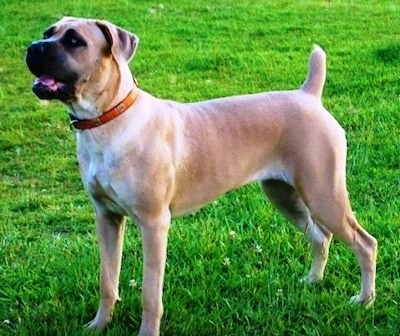
"Castano Savrona aka Cassie comes from a line that includes only the finest of imported and domestic bloodlines. She is the grandaughter of the legendary Arrow. She is AKC and ICCF-registered." Photo courtesy of Brusco's Cane Corso
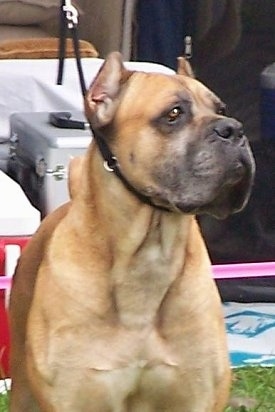
Italian Champion Duce, photo courtesy of Burgwald Kennel, Since 1995
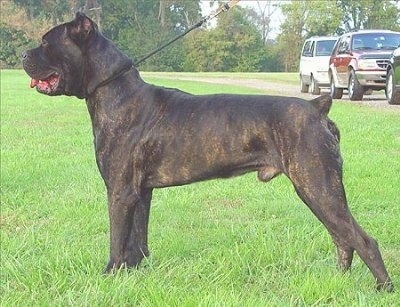
Photo courtesy of Stormy Winns Kennel
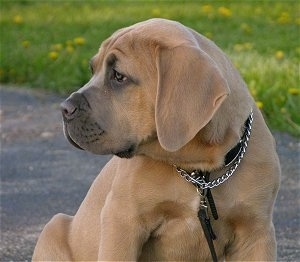
Barone the Cane Corso puppy at 12 weeks