
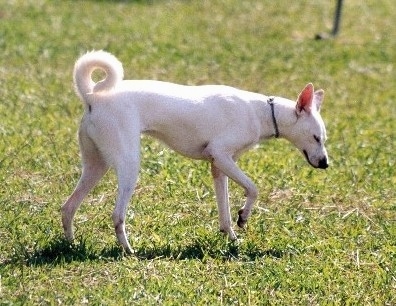
A purebred adult Cretan Hound
kreet-n hound
The Cretan Hound is a slender dog, somewhere in the middle between a scenthound and a sighthound in body, particularly light on its feet (that are oval rather than cat-like) and strong in loin, specially adopted for swift reflexes and high speed over dangerous, rocky terrain. The head is wedge-shaped, elongated and dry, with pricked and very mobile ears that fold backwards like a Greyhound’s during the chase. (Specimens with semi-pricked or drop ears do occur, and the latter tend to be more like a sighthound in type; there is also a smaller variety, something like a Whippet, which little is known about). The skin is fine and tight over the body, and of many colors. The tail is a most important breed characteristic, long and curved upwards, forming a loose or tight ring and covered with a brush of longer hair underneath. The dog is slightly longer than tall, with medium angulations, slender legs and good muscle; the ribcage is spacious but neither too broad nor too rounded and it doesn’t quite reach the point of elbow. The loin is slender yet powerful and there is good tuck-up, with the points of the hipbones slightly prominent. There should be a balance between characteristics of speed and stamina, the conformation being a compromise producing great agility. Flabby, clumsy, heavy individuals not to be tolerated. Colors: pure white, cream, sandy, fawn, grey, black or brindle, bicolored or tricolored.
The Cretan Hound uses both sight and scent on the hunt and has a particular tendency to taste the aerial or ground scent, even to the point of sucking it from pebbles and stones. When the prey is sensed, the tail moves in circular fashion and the hound becomes rigid moments before the chase begins. Meek, affectionate, aristocratic, yet deadly on the chase, it’s a polite hound that comes alive in the presence of prey; clean, gentle, elegant in form and movement, it’s never vulgar or overwhelming in gestures. Slightly reserved with strangers, it’s naturally inquisitive and tolerant. The Cretan Hound lives happily together with other domestic animals but will ruthlessly chase the neighbor’s cat! Excellent, gentle and very affectionate with children. It rarely barks but will give notice of strangers approaching its home; at the farm it will kill mice and rats and it’s not indifferent to feathered game, but the latter use will make the breed lazy and untidy in the hunt; its constitution needs the challenge of the true chase. Make sure you are this dog’s calm, but firm, and confident leader providing enough leadership and exercise to produce a well-balanced canine companion. Proper human to dog communication is essential.
Height: Females 19+ inches (50+ cm) Males 27+ inches (60+ cm)
Weight: 44-66 pounds (20-30 kg)
A fairly healthy breed.
This breed is not recommended for apartment life. It needs space to run.
Robust and healthy, it’s a breed easy to maintain as long as it has plenty of exercise, which includes a daily walk, where the dog is made to heel beside or behind the human holding the lead, as in a dog's mind the leader leads the way and that leader needs to be the humans. It will also greatly enjoy running free in a safe, open space.
About 10-12 years or more.
About 4-6 puppies
Brush with a firm bristle brush, and dry shampoo occasionally. Bathe in mild soap only when necessary. Inspect the feet and mouth for damage after work or exercise sessions. Keep the nails trimmed. This breed is an average shedder.
A primitive hunting breed, its existence on the Greek island of Crete is documented in writing and artifacts for at least 3500 years. It was extensively cultivated and used by the Minoan civilization which, at its peak, dominated over most part of the Aegean, the Cyclades islands and eastern Peloponessus. A tracking and coursing hound, it was always used in chasing and catching hare and wild rabbits on the harsh terrains of its native island. The classic authors praised the Cretan Hounds (Kressai Kynes) as the best hare-hunters known to man and in the ancient times they were exported to the Greek colonies and other countries in Europe, reaching as far as Spain and the British islands, to mix and improve the local hounds. The dogs have many such peculiar traits and they are evidently a truly ancient species, probably the oldest dog breed in Europe. It is possible that their ancestors came from Africa but they were subsequently adapted to this very unique habitat of Crete, an island remote enough to host other unique species of animals also, such as a unique sub-species of wild goat, lynx and others. Isolated there for millennia, these dogs were formed by function to perform a particular and challenging task and they remain pure and unchanged to this day. Due to a long history of struggle against outside enemies, the Cretan people are a freedom-loving race, proud, independent, somewhat suspicious and even stubborn. They don’t like to give their dogs to outsiders and even to this day the best specimens are kept hidden from the public eye. Breeding practices are ruthless and the limited means of the past taught the locals to neuter all but the best males and destroy the dogs that were lacking in the hunt. This resulted in a particularly strong and healthy breed, but also one very small in numbers. For years they were kept secret and even now they rarely leave Crete, apart from the rare occasions they take part in international dog shows held in Athens, where the visitors have the opportunity to meet a true living legend.
Hound
DRA = Dog Registry of America, Inc.

A purebred Cretan Hound at a dog show.